A small group where big feelings make sense.
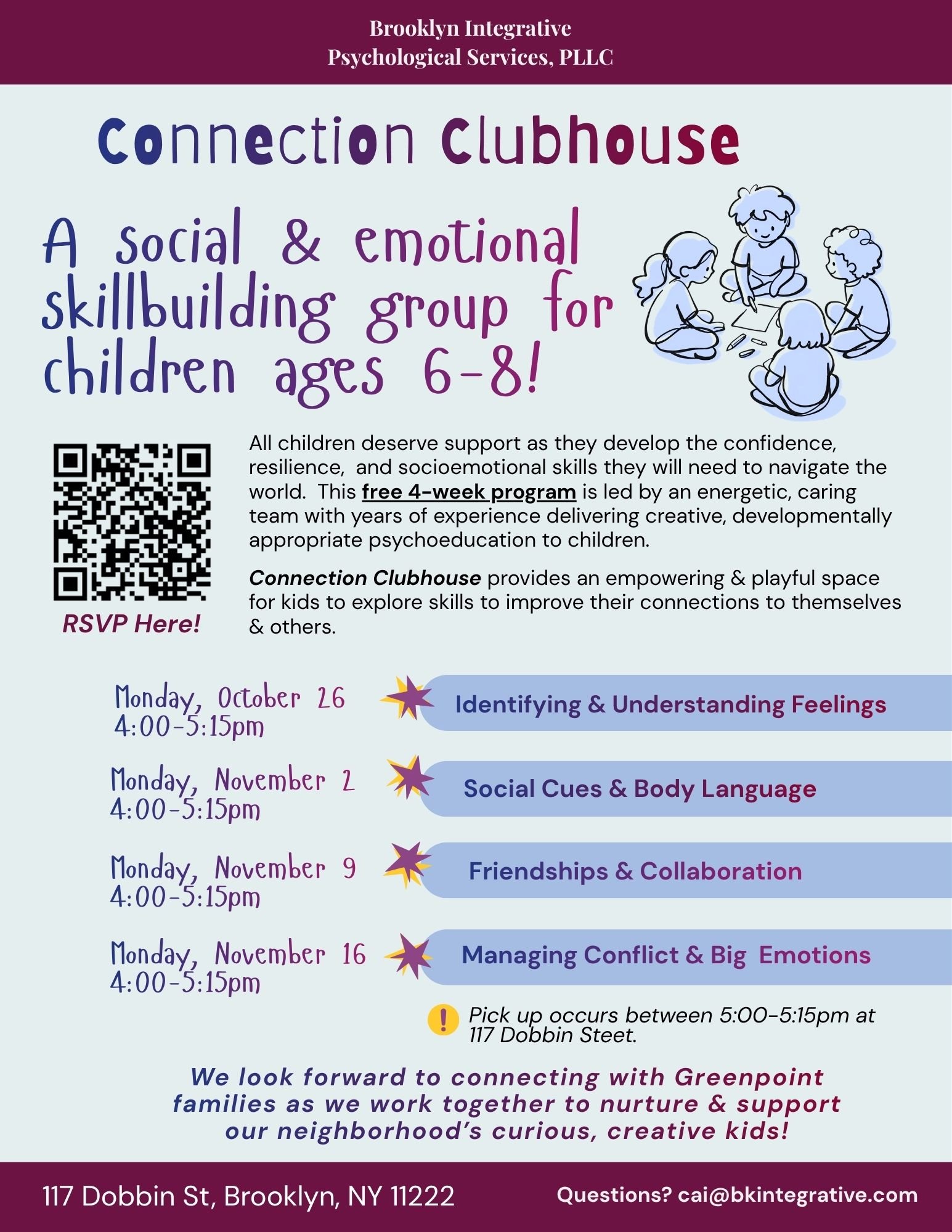
A support group for children ages six to eight where they practice the things that are hard to learn alone: naming a feeling, waiting a turn, repairing after a fight, being a friend.
117 Dobbin Street, Greenpoint · In person · Small group
not by grade
never a classroom
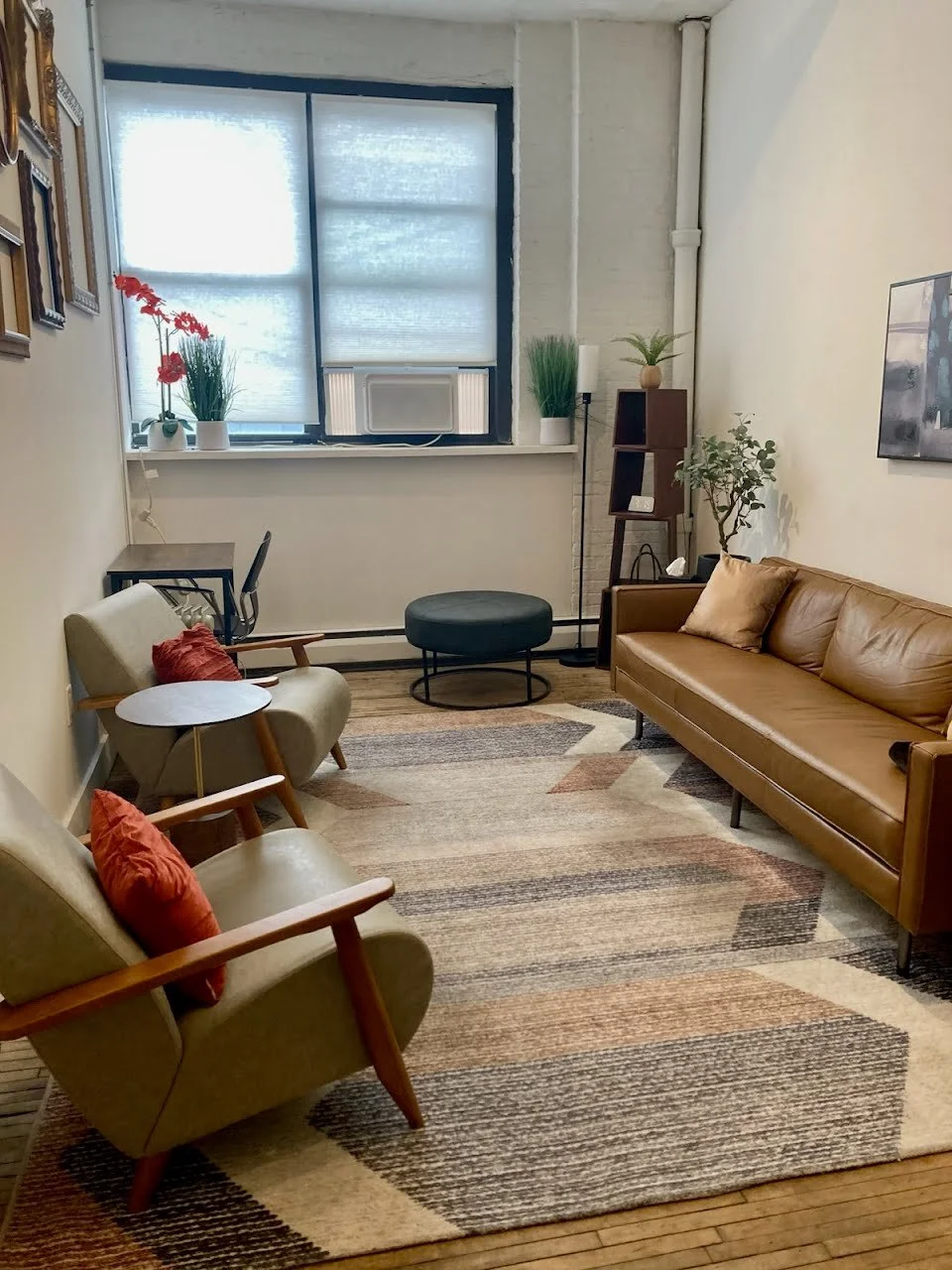
117 Dobbin Street
no application
The short version. Brooklyn Integrative Psychological Services runs a small in-person support group for children ages 6 to 8 at its Greenpoint office, 117 Dobbin Street. The group works on emotional vocabulary, self-regulation, friendship and repair after conflict through play, movement and structured activity. It is led by Cai Yoke (MSW Intern), Gabin Lee (LMSW), and Emma Labella (MSW Intern), who together have years of experience working with children and providing developmentally appropriate psychoeducation. The group is free of charge.
The next cohort begins in October 2026 and BIPS is taking names now as well as for February 2027. Group support can run alongside individual support or on its own, and a child does not need to be an existing BIPS client to join. If you have any questions before registering, contact [email protected]. Once you register, a member of the team will be in touch shortly to learn more about your child and to answer any questions you may have. We are looking forward to working with Greenpoint families to develop programming and resources that nurtures and supports your children!
The child who is doing fine, mostly.
Not in crisis. Not failing. But something is harder than it should be: the meltdowns that last too long, the friendship that keeps breaking, the worry at bedtime, the wobble after a change at home.
Six to eight is a good age for group work. Children this age are old enough to talk about what they feel and young enough that the learning still sticks fast. A lot of what they need to practice, such as taking a turn, losing a game, saying sorry and meaning it, can only really be practiced with other children.
A group gives them that, with an adult in the room who knows what to watch for.
Play is the method, not the warm-up.
Children learn best in environments that provide them a combination of direct instruction, creativity, and play. This space will empower them to explore their feelings and their social skills in a fun and supportive environment.
The structure stays the same week to week, because predictability is what lets a child relax enough to try something new.
- 01
Naming what's happening inside
Building the vocabulary to tell the difference between angry, embarrassed, left out and worried, which is most of the work at this age.
- 02
What to do with a big feeling
Concrete, practical strategies for the moment a feeling gets bigger than the child can hold. Practiced in the room, so they are available outside it.
- 03
Joining in, and being joined
Starting a game, asking to be included, noticing when someone else wants in. Skills that look simple and are not.
- 04
When it goes wrong
Conflict happens in every group, which is the point. Repairing conflict with apologizing, accepting an apology, carrying on is the part children rarely get coached through.
- 05
Parents stay in the loop
You get regular check-ins about what your child is working on and what you can support at home.
Led by Cai Yoke.
Cai came to clinical work after eight years alongside families, advocates and health care workers on campaigns to widen access to Medicaid services — which is to say, a long time spent listening to parents describe what their children need and how hard it is to get it. Cai has also received training in early childhood education and has years of experience creating supportive, artistic spaces for children to learn.

Co-Faciliatated by Gabin Lee.
Gabin is a Licensed Master Social Worker (LMSW) with experience facilitating support groups focused on building coping skills and emotional regulation, and is passionate about supporting children and families with evidence-based care.
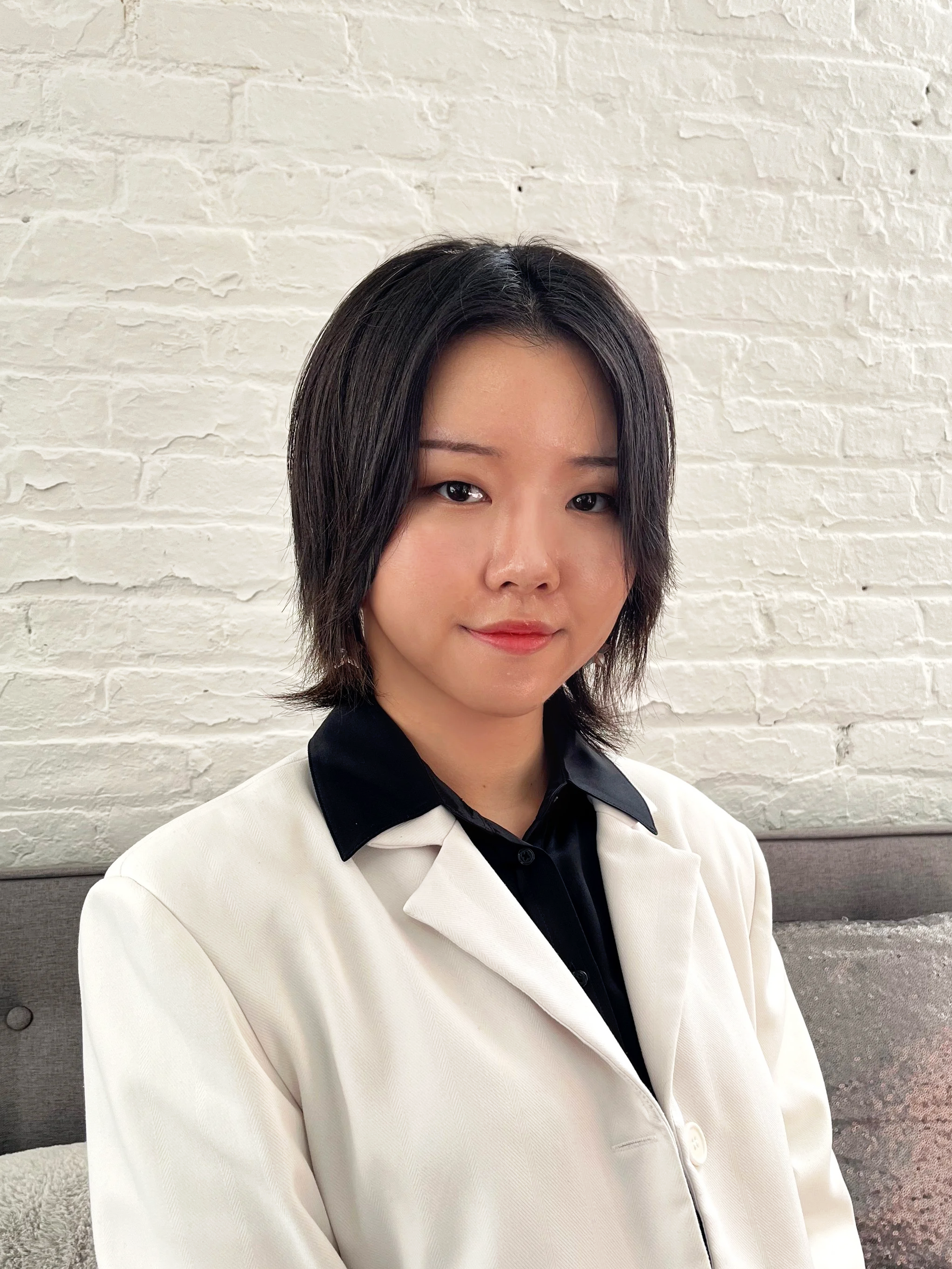
Co-Facilitated by Emma LaBella.
Emma is an MSW graduate student intern at Columbia University with experience facilitating socioemotional learning groups for teens and tweens at Kingsbridge Heights Community Center in the Bronx. As an ABA Therapist with Achieve Beyond, she supported children aged 5–8 with behavioral disorders, focusing on life skills, self-awareness, and emotional regulation. Now at BIPS, she provides practice skills like naming big feelings and resolving conflicts in a safe, playful, patient, and supportive environment!.

Contact Facilitators
Write to Cai directly. Cai runs this group and answers questions about it: whether the group is a fit for your child, what a session actually looks like, or anything you want to ask before committing.
If you would rather your child work with a clinician one to one instead, say so and Cai will pass you to our intake coordinator. No hard feelings, and no wrong answer.
Questions parents ask first.
Is this therapy?
No. Connection Clubhouse is a short-term educational and skill-building group, not psychotherapy, crisis care, a diagnostic service, or a substitute for individualized mental health treatment.
When does the next group start?
The next cohort begins in October 2026, and a further cohort starts in February 2027. Names are being taken for both. Write to Cai and a place can be held while you decide.
How much does it cost?
Nothing. The group is free. There is no fee, no insurance to run, and no sliding scale to apply for. If your child is a fit for the group, they have a place.
Does my child need to already be a BIPS client?
No. Children can join the group whether or not they see anyone at BIPS individually. Some do both, some do only the group.
How many children are in it?
Small on purpose. Few enough that every child gets attention and nobody can hide at the edge of the room, which is the whole reason a group works at this age.
What will children do in the group?
Each week includes structured discussion and developmentally appropriate education about specific social and emotional skills, cooperative games, creative activities, and opportunities to practice new skills in real time. Topics include identifying and understanding feelings; social cues and body language, friendships and collaboration, and managing conflict and big emotions.
What if my child is shy, or a lot?
Both belong here. The child who says nothing and the child who cannot stop moving are often working on two sides of the same thing. Tell us what your child is like and we will be honest about whether this group fits.
Will I know what happens in the group?
Yes. You will get regular check-ins on what your child is working on and what helps at home. We will not repeat everything a child says. They need the room to be theirs, but you will not be in the dark.
May parents or guardians leave during the group?
Yes. Parents and guardians may leave after completing sign-in, but they must remain reachable by phone and able to return promptly if contacted. Prior to the first session, parents must provide a list of authorized individuals for pick-ups as well as a government-issued photo I.D. of each individual authorized for pick-up. A child may stay only after staff have confirmed that all required forms and emergency information are complete.
What if it turns out not to be right?
Then we say so and help you find what is. That might be individual support here, or a referral out. We would rather tell you early than have you spend a term finding out.
How do drop-off and pick up work?
A parent, legal guardian, or adult authorized in writing must sign the child in and out. Staff may request photo identification. Children will not be released unaccompanied. Pickup is between 5:00 and 5:15 p.m. Every child must be picked up no later than 5:15 p.m.
Add your child to the list.
Fill out our registration form or write to Cai directly and say a little about what is going on. You will hear back shortly, and there is no obligation at any point.